
Pintxos del País Vasco: señala con esto/eso/aquello
Pintxos del País Vasco: identifica y señala (esto/eso) en una barra imaginaria.
 Dannis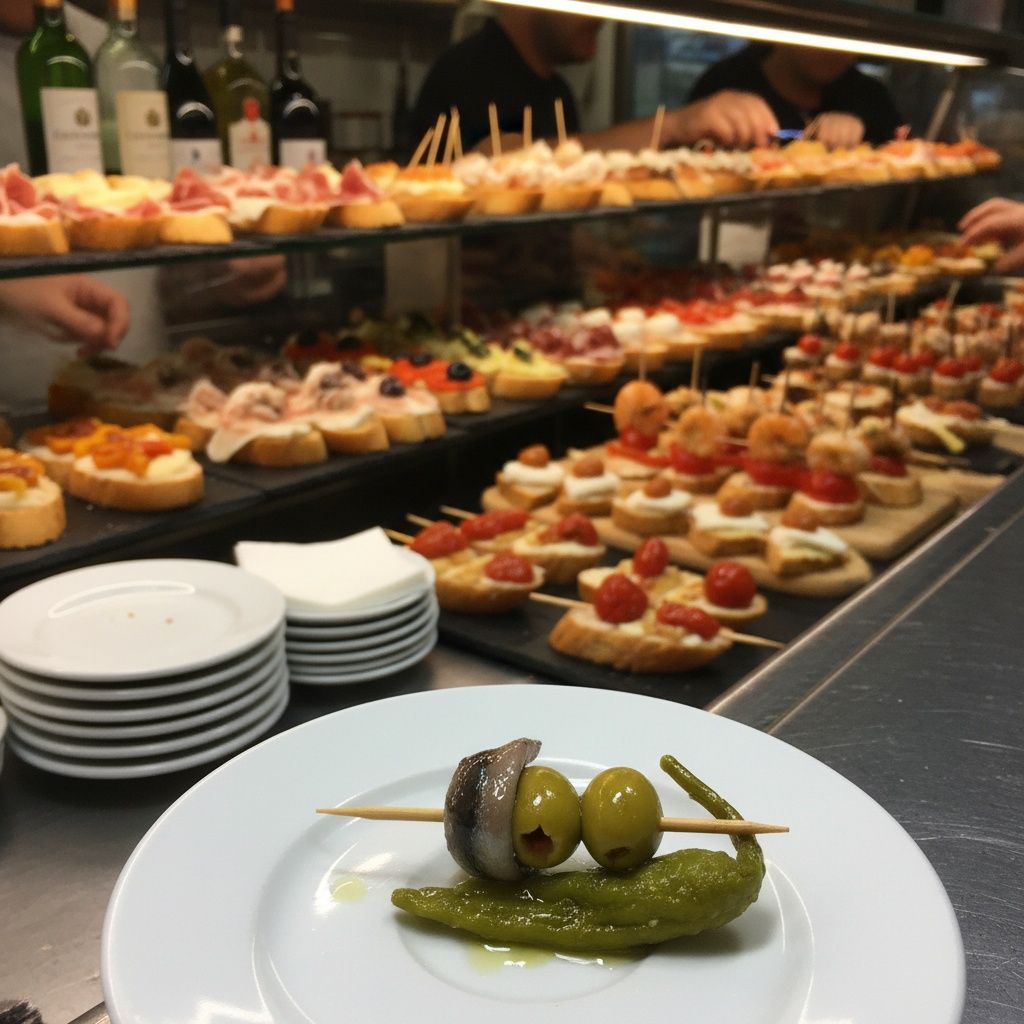
En la barra, delante de ti hay una gilda. Señálala: ___ es “la gilda”.
La gilda is a classic skewer (olive + anchovy + chili pepper), very typical in San Sebastián.
Correct: 0/7
Hints for this Quiz
Think: close to you (the speaker) → esto.
La gilda is a classic skewer (olive + anchovy + chili pepper), very typical in San Sebastián.
In Spanish, "esto" points to something that is close to the speaker. Here the gilda is right in front of you in the display, so you use "esto".
Middle distance → eso.
In bars in the north of Spain it’s normal to see the counter full of different pintxos to choose from while standing at the bar.
For a middle distance (often closer to the other person / not right next to you), Spanish uses "eso".
Far away → aquello.
For objects that are far away, Spanish uses "aquello".
You need the neutral form (not an adjective in front of a noun).
Here you need the neutral pronoun "esto" (for an unknown object/idea). In both lines the speakers are referring to an undefined "what’s this?" → "esto".
Next to the person you’re talking to → ese.
"Next to you" (the person you’re talking to) → "ese pintxo". "Este" is for something near the speaker; "aquel" is for something far away; "esto" is neutral and has no gender, so it doesn’t work with "pintxo".
An idea just mentioned by the other person is picked up again as "eso".
Tapeo/poteo is going from bar to bar, often standing at the counter, sharing small bites; Basque pintxos are the local version, usually presented very carefully.
"Eso" refers back to an idea that the other person has just mentioned (anaphora). "Esto" is for something related to the speaker’s side; "aquello" is for something distant in space or time.
General idea/situation → "eso" (neutral).
La gilda includes chili pepper (a bit spicy), olive and anchovy; it’s a classic in the bars of Donostia (San Sebastián).
We’re talking about the general idea/situation ("that" in English) → the neutral "eso". "Esa" would point to a specific feminine object; here it’s a general statement about "that".
Discover next:

Do you like it? Want more?
Free & quick registration, no subscriptions!
🤗
For expats and alike – unlike any other language app you've tried!
🎮
Learn by scrolling and playing!
💪
Real grammar and idioms to sound like locals!
🧠
Endless FYP feed for language learning
🧠
Endless FYP feed for language learning
Related articles
Materials on related topics will help expand your understanding of the topics: