
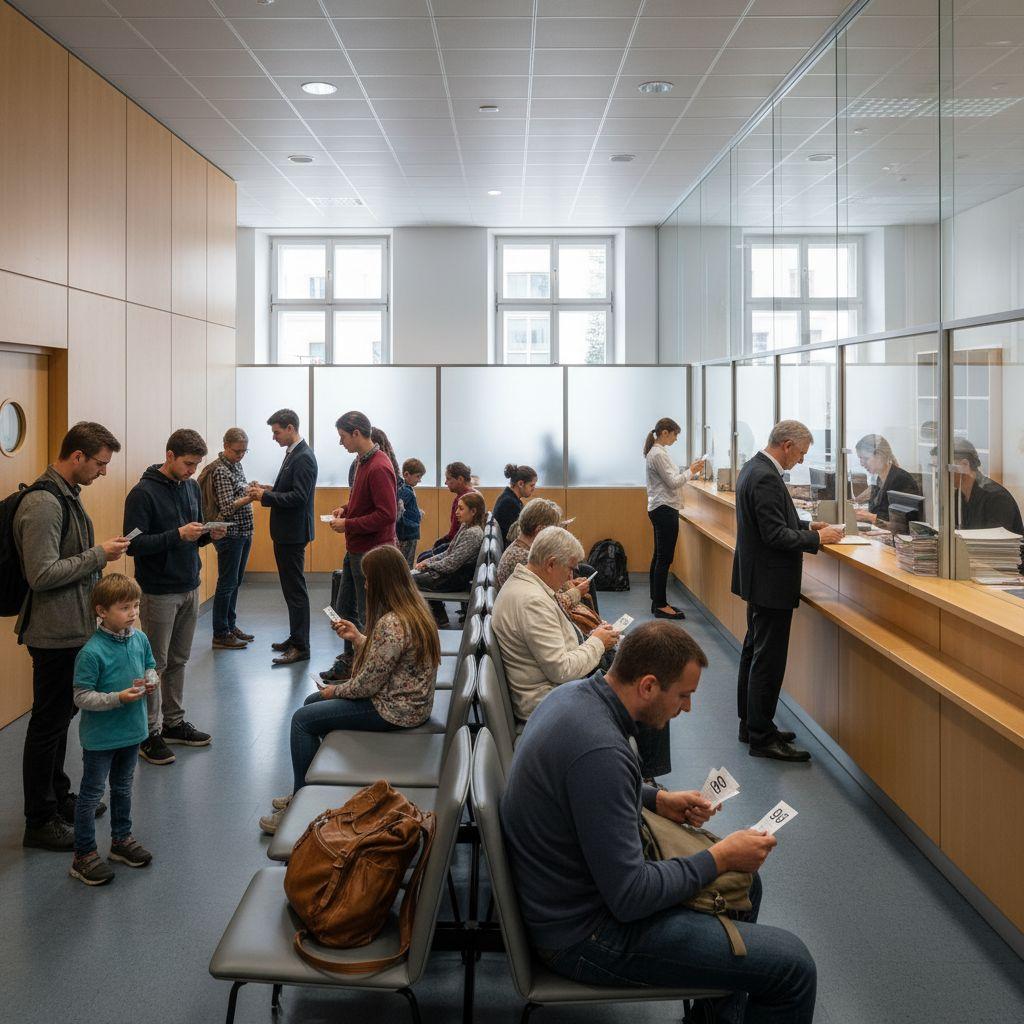
Du oder Sie? Am Schalter der Ausländerbehörde
Mini-Szenen: „du“ oder „Sie“? Richtige Anrede und Verbform wählen (3 kurze Dialoge).
 Dannis
--:--
--:--
– Guten Morgen, ich habe einen Termin um zehn Uhr.
– Guten Morgen. Sind Sie Herr Miller?
– Ja, genau. Können Sie mir sagen, wo ich das Formular bekomme?
– Natürlich. Herr Miller, Sie können das Formular hier am Schalter ausfüllen.
– Super, danke. Äh... kannst du mir kurz beim ersten Feld helfen?
– Gern, aber bitte sagen Sie hier „Sie“. Ich helfe Ihnen sofort.
– Oh, Entschuldigung! Können Sie mir kurz helfen?
– Sehr gut. Schreiben Sie bitte „verheiratet“ oder „ledig“.
– Kannst du nachher die E-Mails prüfen?
– Ja, mache ich. Unter Kollegen duzen wir uns, aber mit Kundinnen und Kunden sagen wir „Sie“. — Herr Miller, Sie müssen noch hier unterschreiben.
– Danke, Frau Keller. Jetzt kann ich den Antrag abgeben.
Comprehension check:
What form of address did the clerk ask the customer to use at the counter?
Sie (formal)
du (informal)
First name only
No address at all
In German public offices, you normally use the formal address Sie with customers. The clerk explicitly corrected the customer to use Sie.
Listen for “Bitte sagen Sie hier ‘Sie’.”
Fill the blank with the correct polite form from the dialogue: “_____ mir kurz helfen?”
Choose the version used after the correction.
Können Sie
Kannst du
Könnten du
Konnte Sie
After the correction, the customer uses the formal question: Können Sie mir kurz helfen? The du-form would be Kannst du.
Remember: Sie takes the infinitive form of the verb (können).
Why does the supervisor use du with the clerk while whispering aside?
Because colleagues often duzen each other
Because the customer left the room
Because they are family
Because du is required in immigration offices
Among colleagues, using du is common in many workplaces. With customers, they use Sie.
Contrast how staff address each other vs. how they address the customer.
Discover next:

Do you like it? Want more?
Free & quick registration, no subscriptions!
🤗
For expats and alike – unlike any other language app you've tried!
🎮
Learn by scrolling and playing!
💪
Real grammar and idioms to sound like locals!
🧠
Endless FYP feed for language learning
🧠
Endless FYP feed for language learning
Related articles
Materials on related topics will help expand your understanding of the topics: