
Comparativos con tapas por ciudades
Comparativos con tapas de distintas ciudades: completa frases.
 Dannis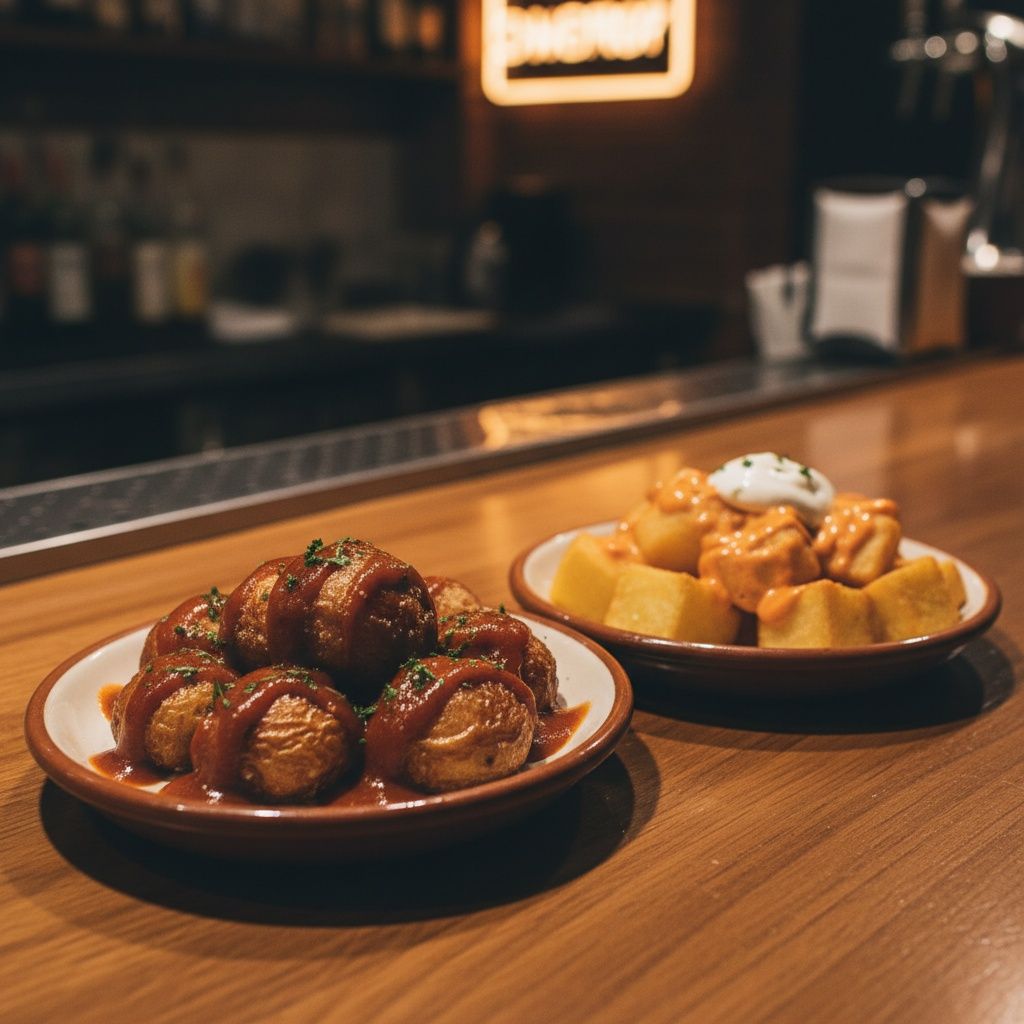
Completa: Las papas arrugadas con mojo de Canarias son ___ picantes ___ las patatas bravas de Madrid.
Culture: Papas arrugadas con mojo (a spicy red sauce or a green cilantro sauce) are typical from the Canary Islands.
Correct: 0/7
Hints for this Quiz
Remember: más/menos + adj + que. Check the agreement of the adjective: "picantes".
Culture: Papas arrugadas con mojo (a spicy red sauce or a green cilantro sauce) are typical from the Canary Islands.
Grammar tip: the comparison pattern is "más/menos + adjetivo + que". Here the adjective is in the plural: "picantes". The task is to choose the correct structure, not the “real‑life fact” about which dish is actually spicier.
Choose the structure with an adjective: más/menos + creativo + que.
Culture: In the Basque Country pintxos are often very elaborate.
Here we need the regular comparative with an adjective: "más creativos que". The adjective agrees in gender and number with "pintxos" (plural).
Remember: "barato" is an adjective. The structure is the same: más/menos + adj + que.
Culture: In Granada, Almería, Jaén and León it is common to get a free tapa with your drink, which is great for a student’s budget.
Meaning: because of the free tapa, the final cost is usually lower. So we choose "más barato que".
Memorize: bueno → mejor, malo → peor.
Culture: Tortilla de patatas is a symbol of Spanish home cooking.
With the adjectives "bueno/malo" we use the forms "mejor/peor" (not *más bueno / menos malo*).
Make the adjective agree with "paella": "famosa" (feminine, singular).
Culture: Paella comes from Valencia and is a very well‑known symbol of its gastronomy.
We are practicing the comparative structure with an adjective: "más famosa que".
Choose "más pequeña que": that’s the natural way to say it.
Culture: Tapas are small portions served to accompany a drink.
In Spanish it is more natural to say "más pequeña que" than "menos grande que".
Look for the form with "menos": menos + adjetivo + que.
Culture: Mojo rojo (picón) is usually spicy; the green one is made with cilantro.
We want the contrast "menos ... que": the green sauce is usually less spicy than the red one.
Discover next:

Do you like it? Want more?
Free & quick registration, no subscriptions!
🤗
For expats and alike – unlike any other language app you've tried!
🎮
Learn by scrolling and playing!
💪
Real grammar and idioms to sound like locals!
🧠
Endless FYP feed for language learning
🧠
Endless FYP feed for language learning
Related articles
Materials on related topics will help expand your understanding of the topics: