
Perífrasis en directo: ir a + infinitivo vs acabar de + infinitivo
Perífrasis en directo: completa 3 frases con ir a / acabar de.
 Dannis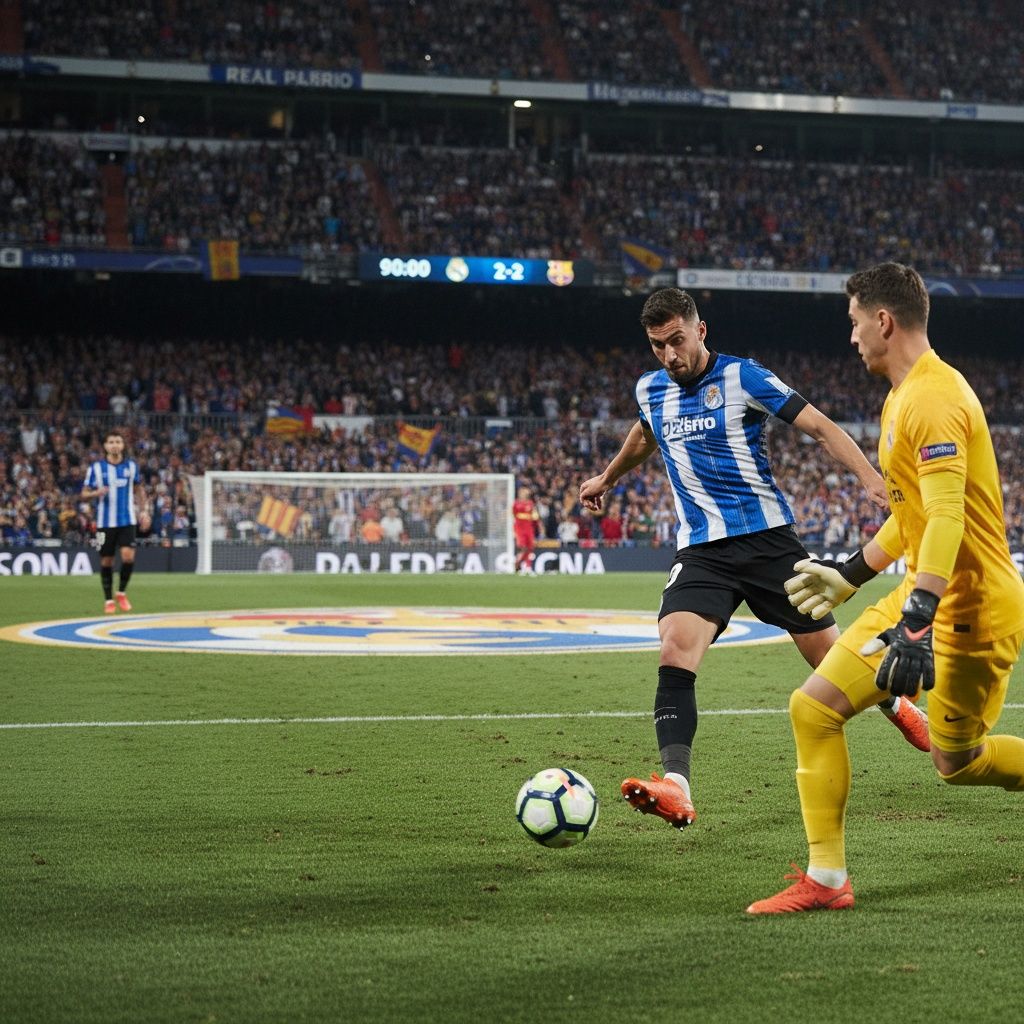
El delantero está solo delante del portero. Completa: "El delantero ____ marcar".
Correct: 0/6
Hints for this Quiz
Think: "about to score" → ir a + infinitivo.
ir a + infinitivo = very near future ("about to happen"). Here: va a marcar = he’s about to score / he will score any second. Vocabulary: marcar (to score a goal) — a typical verb in football.
"Has just" → acabar de + infinitivo.
acabar de + infinitivo = something that has just happened. Here the final score is already known — the team has just won. In Spanish commentaries, extra time is often called en el descuento (in stoppage time / added time).
We’re looking for the phrase "let’s see", not a future action.
Vamos a ver is a discourse phrase meaning "let’s see". It’s not the grammatical periphrasis for a future action, but a commentator’s introductory expression.
"Has just" → acabar de + infinitivo.
acabar de + infinitivo = an action that has just happened: acaba de parar (has just saved it). Vocabulary: parar (when the goalkeeper saves a shot) — a frequent verb in football.
It’s a prediction about the near future → ir a + infinitivo.
ir a + infinitivo expresses near future / a prediction: va a ganar = it’s going to win / will very likely win. This is an expectation, not a confirmed fact.
The event already happened: "has just scored" → acabar de + infinitivo.
acaba de marcar = "has just scored". A typical commentator line: ¡Qué golazo! (what a great goal!) — a very common expression in broadcasts. Vocabulary: marcar un gol = "to score a goal".
Discover next:

Do you like it? Want more?
Free & quick registration, no subscriptions!
🤗
For expats and alike – unlike any other language app you've tried!
🎮
Learn by scrolling and playing!
💪
Real grammar and idioms to sound like locals!
🧠
Endless FYP feed for language learning
🧠
Endless FYP feed for language learning
Related articles
Materials on related topics will help expand your understanding of the topics: