
Höflich am Schalter: Imperativ → Konjunktiv II
Höflichkeitstraining: Imperativ-Sätze in Konjunktiv-II-Bitten umformulieren (3 Beispiele am Schalter).
 Dannis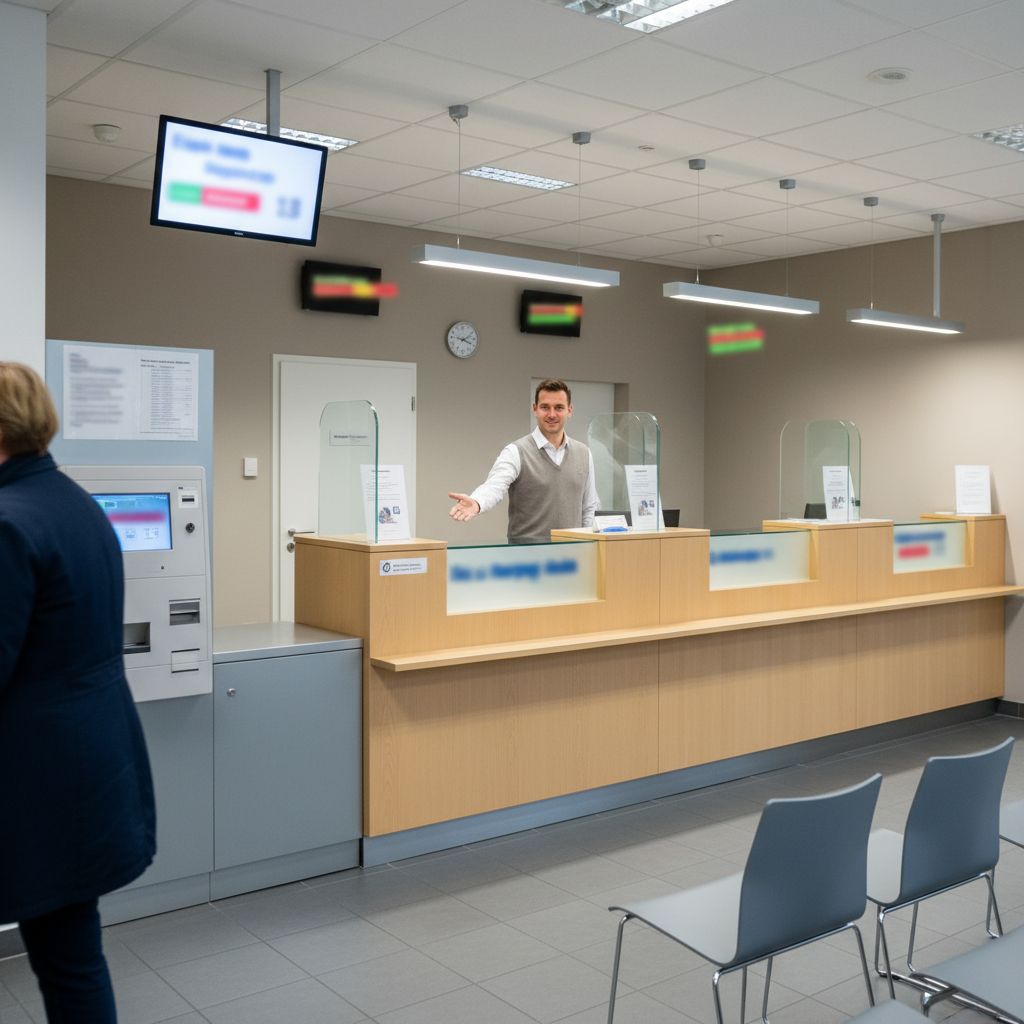
Formulieren Sie mit „können“: „Kommen Sie bitte zum Schalter 3.“ Welche Variante ist richtig?
Correct: 0/7
Hints for this Quiz
Look for the structure: Könnten Sie + Infinitiv am Satzende.
We target the Konjunktiv II with “können”: Könnten Sie … kommen? The other options are either with würden or not in Konjunktiv II/polite standard.
Prefer Konjunktiv II (würden/könnten) with Sie-form for polite requests.
Konjunktiv II (würden) makes the request polite and formal. Imperatives or casual ‘du’ are less appropriate at the office.
Word order: Pronoun (mir) comes before the full verb: Könnten Sie mir … geben?
Könnten Sie + Dativpronomen vor dem Vollverb is idiomatic and polite. The ‘du’-form and wrong word order are not appropriate in this formal situation.
Check verb placement and polite “Sie” agreement.
Only the first option has correct word order and agreement. The others have errors (verb placement or Sie/du mismatch).
Look for “Könnten/Würden Sie … bitte …?” with Sie-form.
Konjunktiv II with ‘Sie’ is the polite, formal choice. Imperatives or ‘du’ are not suitable in this context.
In emails to authorities, use Konjunktiv II and add “bitte” for polite tone.
In writing, Konjunktiv II (“Würden Sie … bitte …?”) is polite and standard. The others sound too direct or rude.
Use: Würden Sie bitte + … + (mit)bringen at the end.
Requested auxiliary is ‘würden’. Option 1 has correct structure and the separable verb ‘mitbringen’ in infinitive at the end.
Discover next:

Do you like it? Want more?
Free & quick registration, no subscriptions!
🤗
For expats and alike – unlike any other language app you've tried!
🎮
Learn by scrolling and playing!
💪
Real grammar and idioms to sound like locals!
🧠
Endless FYP feed for language learning
🧠
Endless FYP feed for language learning
Related articles
Materials on related topics will help expand your understanding of the topics: