
Precios y ofertas en el súper
Preguntas rápidas de precio y ofertas para productos frescos.
 Dannis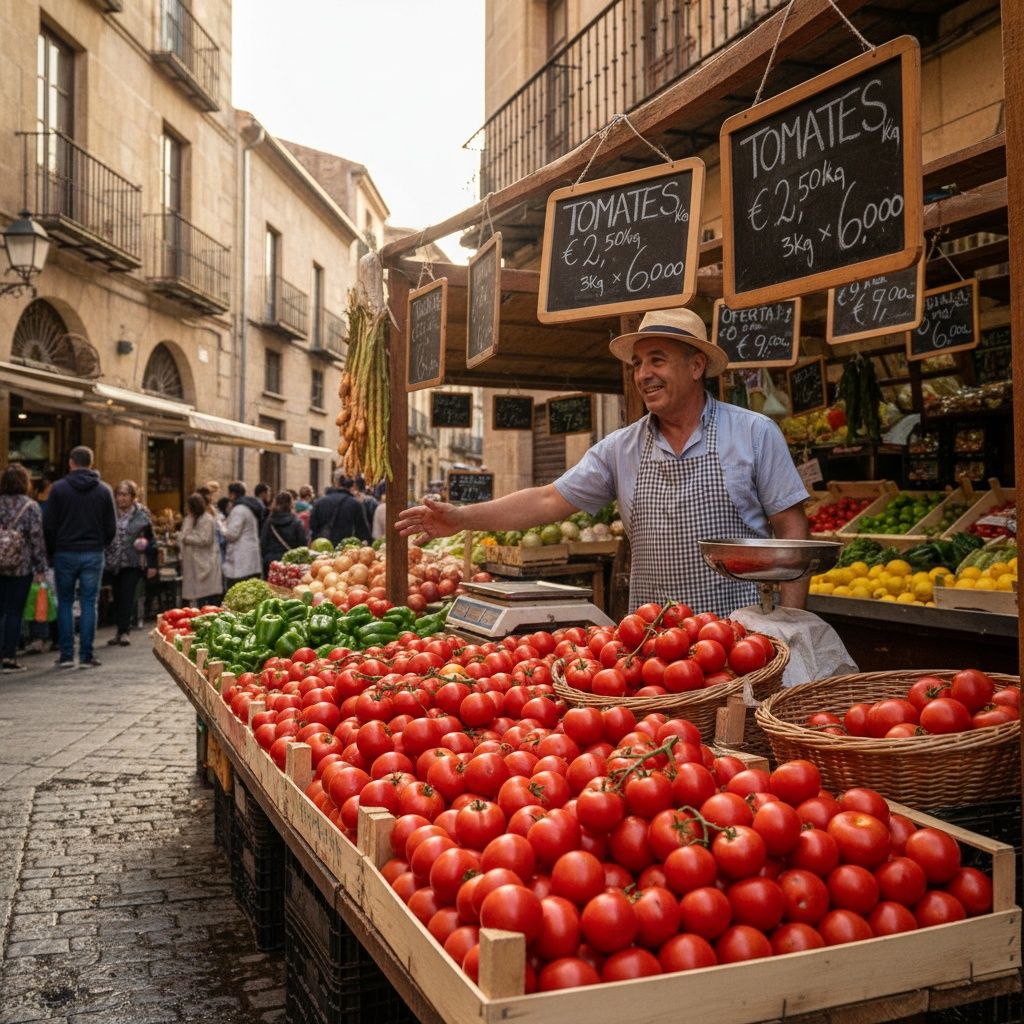
Completa con «estar»: ____ el kilo de tomates?
Correct: 0/8
Hints for this Quiz
Think: you want the price per kilo, not the total or the location.
Use ¿A cuánto está…? to ask the price per kilo. This is a common price question in Spain, listed among supermarket phrases . It refers to the unit “kilo,” a standard measure for fresh produce .
You’re pointing at one pineapple, not asking per kilo.
¿Qué precio tiene…? works well to ask the price of a specific item or unit, not by weight. It’s one of the core supermarket price questions in Spain .
You want to confirm that the product is on sale.
Está de oferta means “it’s on sale,” exactly the expression shoppers use for discounts . In Spanish stores you’ll also see productos “en oferta” (on offer) .
You’re holding one piece and asking the total price for that piece.
¿Cuánto vale esto? is the natural question when pointing to a specific item in your hand. It’s one of the standard price questions taught for shopping in Spain .
Multiply the price per kilo by the number of kilos.
You pay price-per-kilo times kilos. Kilo is the usual unit for fresh produce in Spain .
Cashiers often reply with “Son + amount.”
Vendors commonly answer with Son + cantidad: e.g., “Son 12,50€” is a typical cashier line in Spain .
It uses the verb “estar” + “de oferta”.
Use estar de oferta to say an item is on sale. You’ll also see en oferta on signs in stores .
Use the plural of the set phrase for per‑kilo prices.
With plural items you can say ¿A cuánto están…? to ask the per‑kilo price. This pattern comes from the standard phrase for prices by weight, “¿A cuánto está el kilo?” , and relies on the kilo unit for fresh produce .
Discover next:

Do you like it? Want more?
Free & quick registration, no subscriptions!
🤗
For expats and alike – unlike any other language app you've tried!
🎮
Learn by scrolling and playing!
💪
Real grammar and idioms to sound like locals!
🧠
Endless FYP feed for language learning
🧠
Endless FYP feed for language learning
Related articles
Materials on related topics will help expand your understanding of the topics: