
Hablar y pedir en barra como un local: poner, tomar, llevar y traer
Role‑play corto: pedir en barra y hablar de ingredientes como un local.
 Dannis
Keywords:
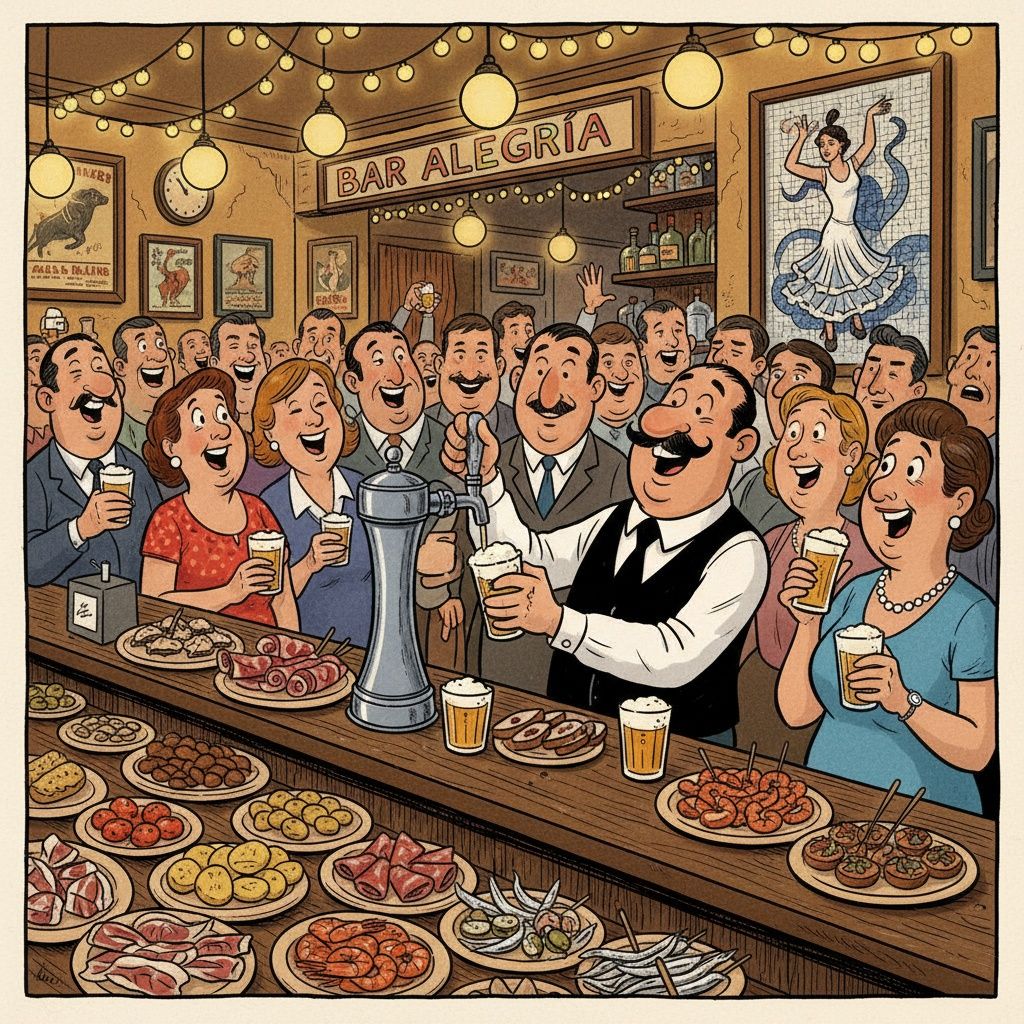
En una barra en España, elige la frase más natural para pedir cerveza.
En el tapeo es normal ir de bar en bar y pedir de pie en la barra. Frases coloquiales como “ponme / me pones” suenan muy naturales en España. Tapear = visitar varios bares, a menudo entre las 20:00 y 22:00.
Correct: 0/7
Hints for this Quiz
Think of the typical bartender’s phrase: "¿Qué te pongo?" — the verb should match.
En el tapeo es normal ir de bar en bar y pedir de pie en la barra. Frases coloquiales como “ponme / me pones” suenan muy naturales en España. Tapear = visitar varios bares, a menudo entre las 20:00 y 22:00.
In bars in Spain, customers often say "Ponme… / Me pones…" — this sounds local and polite. Options with "traer" and "quiero" are possible, but they’re less natural for ordering at the bar.
Think: which verb means "to contain (as ingredients)"?
Think of English: "the dish contains…" — in Spanish this is "llevar". For example: "La paella lleva arroz". "Traer" = "to bring", "tomar" = "to have / to drink / to take".
"Bring (here, to me)" — which verb is that?
From the speaker’s point of view, "bring it to me" is "traer". "Llevar" is "to take (somewhere away from the speaker)". You can also use "¿Me pones…?" to order, but with "a la mesa" it’s more natural to say "¿Me traes…?"
Idiom: "to go for a drink / a bite" = "____ algo".
In Spain it’s very common to "tomar algo" (coffee, beers, tapas) in cafés and bars — it’s part of everyday social life.
In colloquial Spanish, "tomar algo" = "to go for a drink / a bite". "Beber" is the neutral "to drink", but in this fixed expression people usually say "tomar". "Poner" is not used here.
Look for the equivalent of "to go / takeaway".
In Spanish, "to go / takeaway" is "para llevar". "Traer" means "to bring", and "para tomar" sounds incomplete (people usually say "para tomar aquí").
This is a polite "offer" from the bartender.
In a bar context, "poner" = "servir / ofrecer". The sentence is equivalent to "¿Quieres algo más?" The other options aren’t related to serving customers.
Polite formula: "Cuando puedas…" + a request.
In Spain the bill doesn’t just arrive by itself — you have to ask for it explicitly.
A polite, colloquial and very typical Spanish option is "Cuando puedas, la cuenta, por favor". The other options sound rude or too imperative.
Discover next:

Do you like it? Want more?
Free & quick registration, no subscriptions!
🤗
For expats and alike – unlike any other language app you've tried!
🎮
Learn by scrolling and playing!
💪
Real grammar and idioms to sound like locals!
🧠
Endless FYP feed for language learning
🧠
Endless FYP feed for language learning
Related articles
Materials on related topics will help expand your understanding of the topics: