
Comisaría: toma de huellas — imperativos con usted
Microdiálogo en comisaría (toma de huellas) practicando imperativos con usted.
 Dannis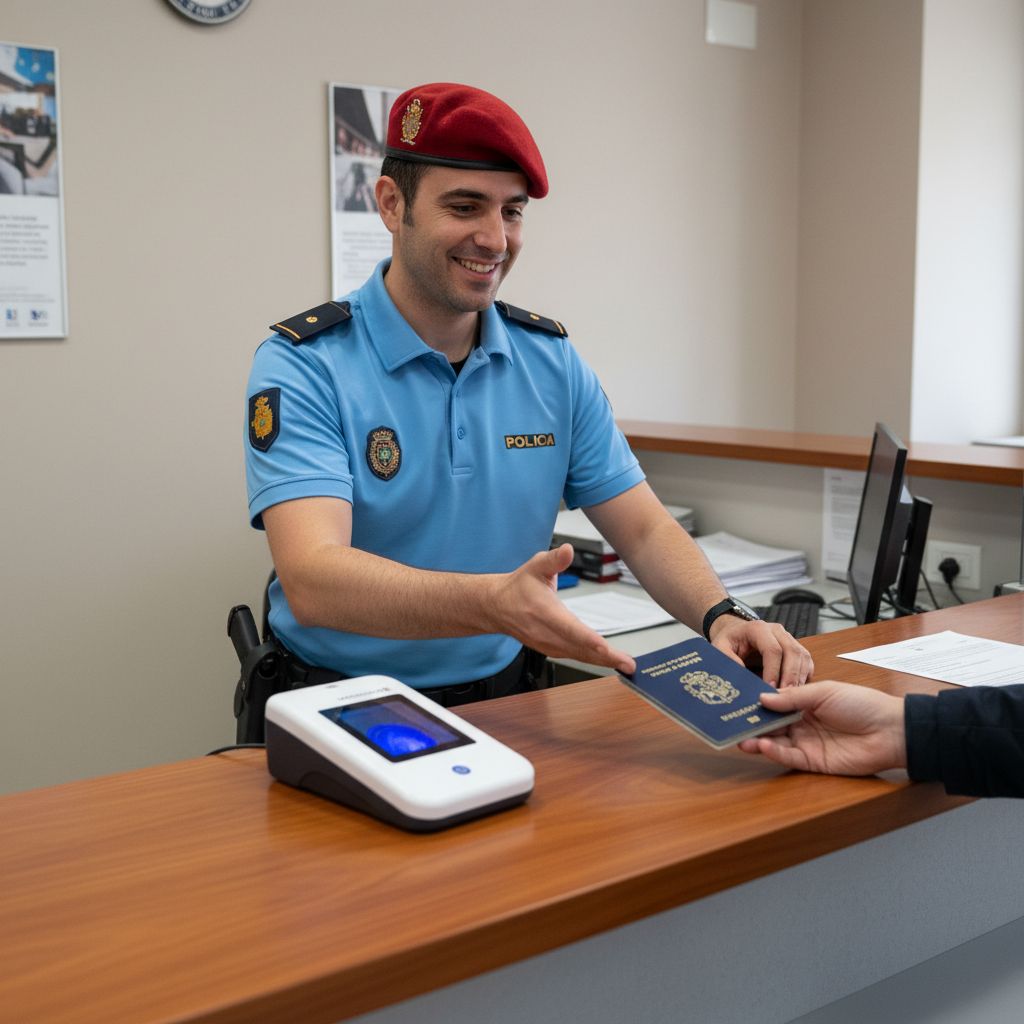
Complete la frase del funcionario: “_____ el pasaporte, por favor.”
Situation: window at the police station (fingerprinting appointment).
Correct: 0/8
Hints for this Quiz
Think: a polite request to one person (usted), not "tú" and not "vosotros".
Situation: window at the police station (fingerprinting appointment).
In formal address with "usted" we use the imperative form "Muestre". This is the kind of line you’ll hear in the model dialogue about giving fingerprints: "Dígame su nombre y muéstreme el pasaporte… Firme aquí, por favor."
Remember: in affirmative imperative forms with usted, clitic pronouns go after the verb and are written together with it.
In the affirmative imperative with "usted", pronouns are attached to the end of the verb: "Muéstreme…" → "Muéstremelo". Compare a similar pattern from the dialogues: "Déjeme su pasaporte" (the pronoun "me" is attached to the imperative form).
This is a request to one person in an official situation.
At the police station they often ask for photos. The correct form is the polite imperative with usted: "Traiga". In the dialogues about the TIE you’ll see a request for photos with a white background (fondo blanco).
Look for the usted formula that people really use at the service window.
Signing documents.
The fixed and most natural formula is "Firme aquí, por favor", as in the police-station dialogue. The form "Firma…" corresponds to "tú".
It’s not the card itself; it’s the piece of paper you need to keep.
A "resguardo" is a paper document that confirms you have submitted a procedure or its current status; later, together with your passport, you can use it to collect your residence card. See the glossary entry for "resguardo" and the descriptions of the procedure.
Negative form: the pronouns go before the verb.
In negative imperative constructions, pronouns are placed before the verb form: "No me lo entregue". Compare this with the pronoun order in an affirmative example such as "Déjeme su pasaporte".
Think of the list for "toma de huellas": passport, photo, appointment and… which fee payment?
For the "toma de huellas" appointment, you normally need the proof of payment for form 790‑012, in addition to your passport, photo, etc. See the checklist.
This is not "tú" ("Dime"), but a polite address to one person.
The service formula "Dígame…" corresponds to usted. In the model dialogue you hear: "Dígame su nombre…"
Discover next:

Do you like it? Want more?
Free & quick registration, no subscriptions!
🤗
For expats and alike – unlike any other language app you've tried!
🎮
Learn by scrolling and playing!
💪
Real grammar and idioms to sound like locals!
🧠
Endless FYP feed for language learning
🧠
Endless FYP feed for language learning
Related articles
Materials on related topics will help expand your understanding of the topics: